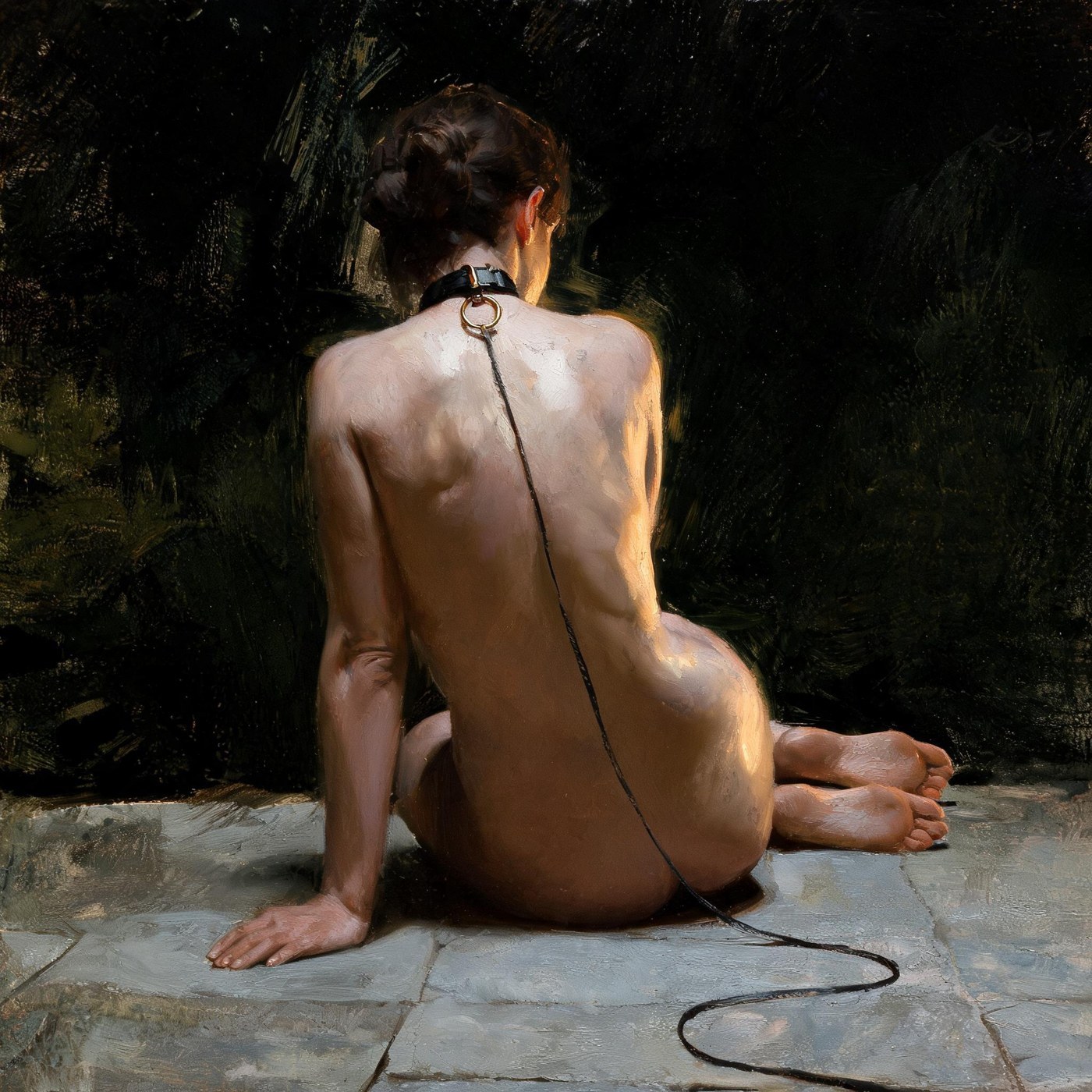
A collar is a noun. A leash is a verb.
That is the entire difference and everything else in this essay follows from it. A collar states a fact about a woman that remains true while she sleeps, while she shops, while she sits through a meeting with her chin up and a scarf on. It is a condition. It requires nobody’s participation to go on being the case.
A leash is not a condition. A leash is an event, in progress, right now, requiring two people. It cannot be worn. It can only be used.
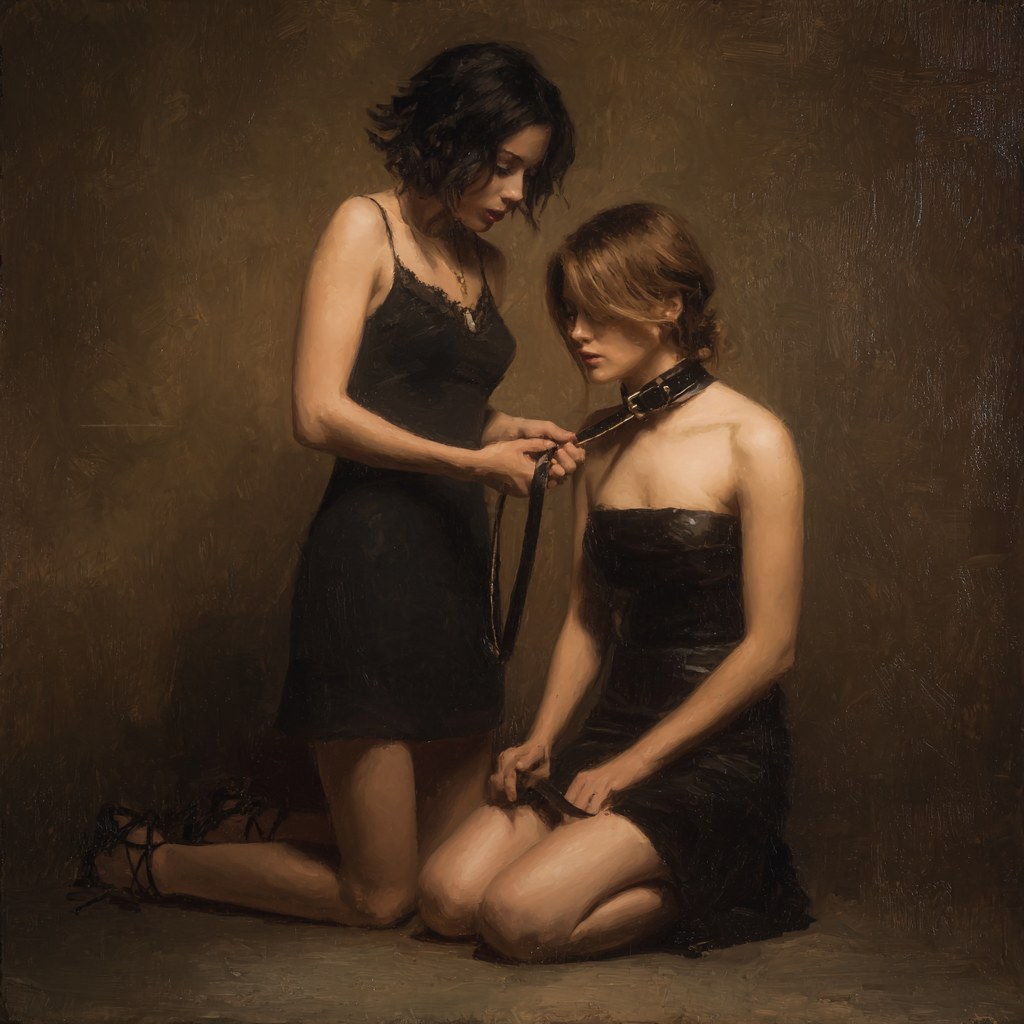
Women who are drawn to one are not always drawn to the other, and the difference tells you a great deal about what they actually want. The collar woman wants to belong to somebody. The leash woman wants to be handled.
I. THE OBJECT
Take the thing itself seriously for a moment, because the design is not arbitrary.
At one end there is a clip. At the other there is a loop sized for a human hand. Between them is a length of leather or chain chosen for a specific reason, because length here is not a detail — length is the whole instrument. Two feet is a different arrangement from six. Two feet means she walks at a hip. Six means she can be sent ahead and reeled back. Eighteen inches means she cannot stand upright.
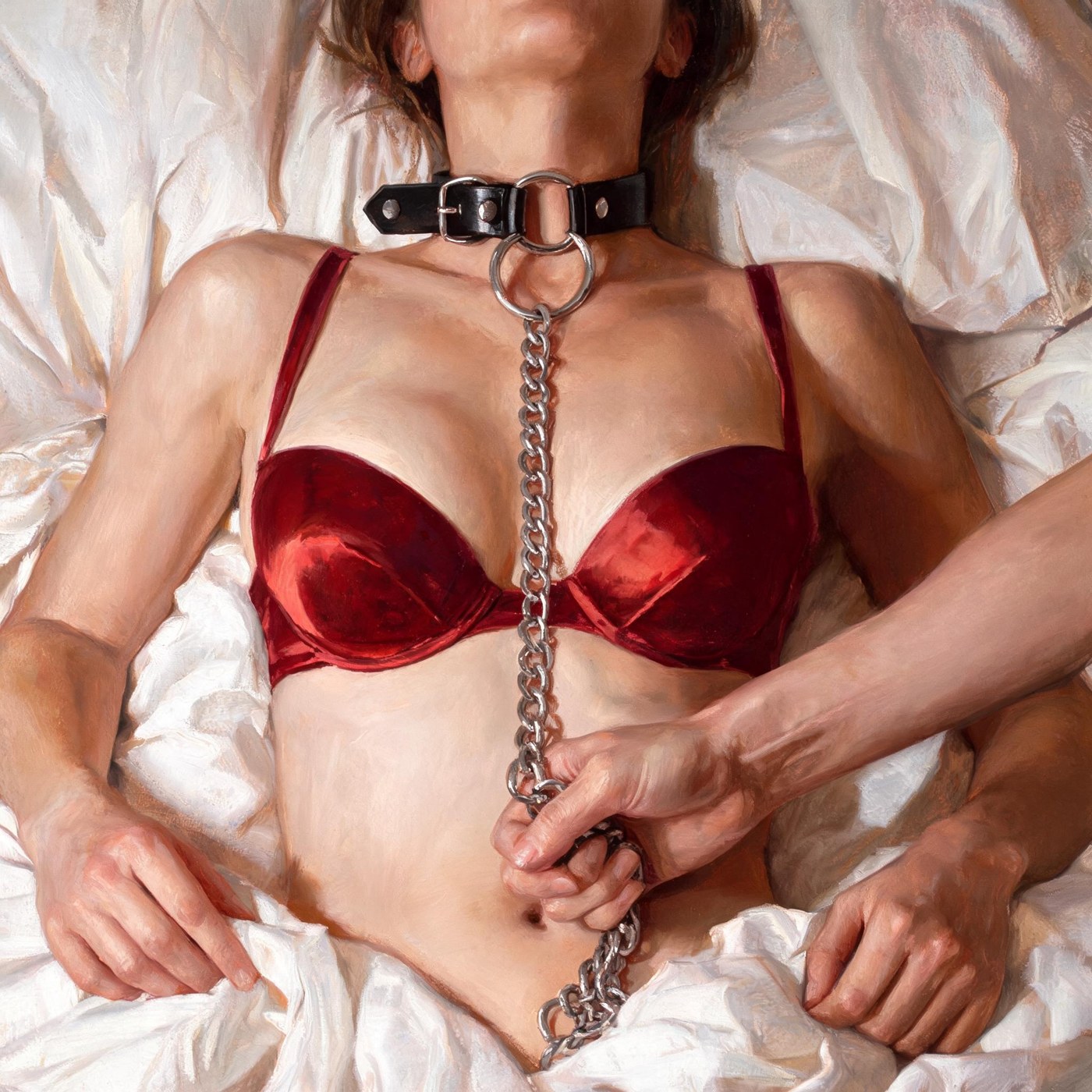
Note what the design assumes. It assumes one party has hands free and the other has a throat. It assumes one is thinking about where to go and the other is not. Every leash ever made is a piece of hardware with an opinion built into it about which of the two women present is the subject of the sentence.
And note that it has a handle. A collar has no handle. Somebody sat down and decided this object required a place to be held, and that decision is doing more erotic work than the buckle, the leather, the weight or the sound.
II. THE SLACK
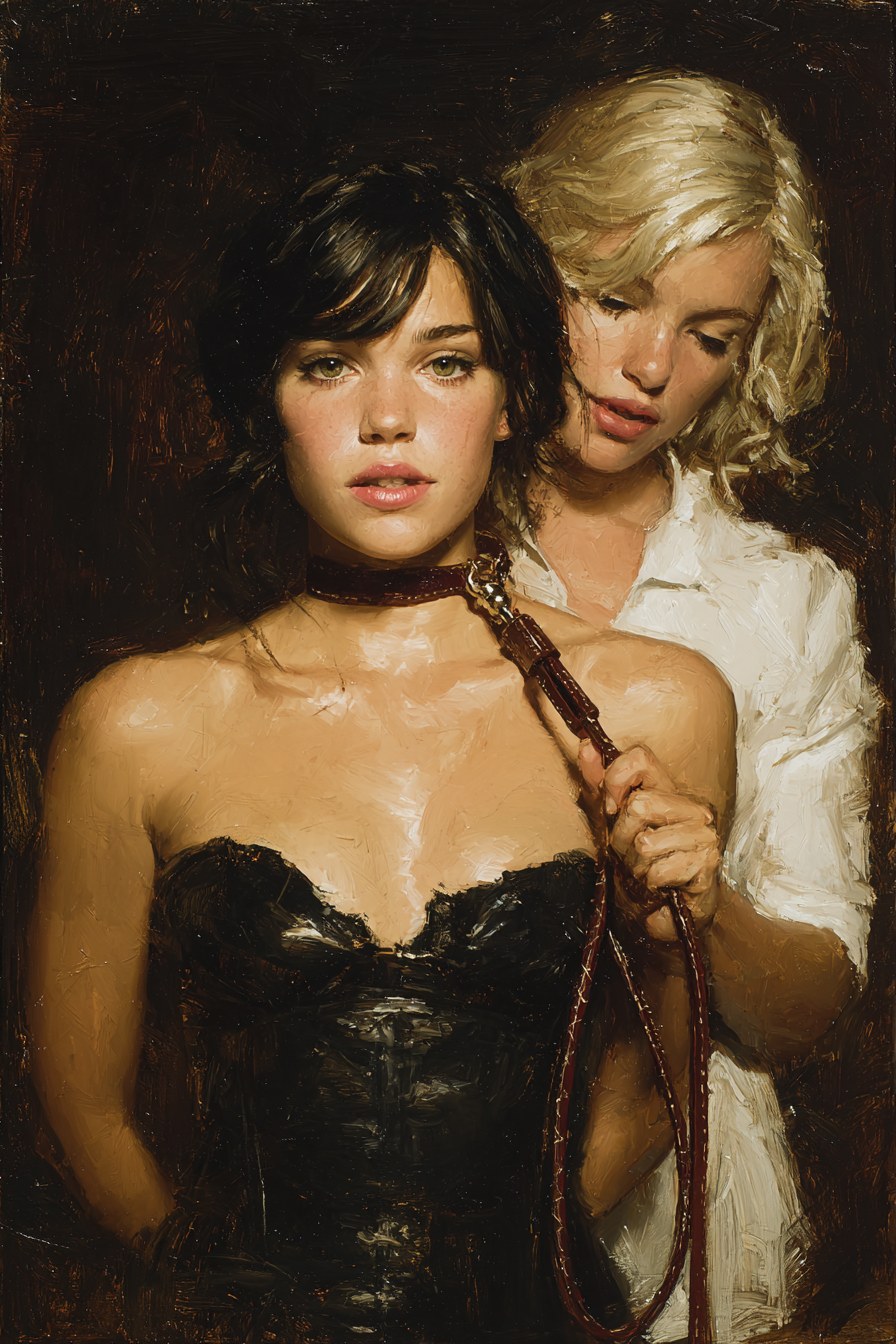
The leash is not the point. The slack in the leash is the point.

At any given second she is in one of three states, and she is aware of which one with an attention she has never given to anything else in her life.
Slack. The line hangs. She has three or four inches of freedom in any direction and could turn her head if she wanted to. She almost never wants to. Slack does not feel like freedom, it feels like permission that could be withdrawn, and a woman on a slack leash is doing more self-regulation than a woman on a tight one — because the tight one has already been decided for her and the slack one is a test she is grading herself on.
Taut. The line is straight and there is weight in it. This is the state in which she cannot forget for even one second where she is, whose she is, or what will happen if she moves eight inches to the left. Most women describe this as the calm one. Nothing is required of her but to keep the tension exactly as it is, which is a job so simple and so absorbing that everything else in her head goes quiet.

Changing. This is the erotic content. The transition between the other two — the moment she feels the line begin to lift off her collarbone, or begin to fall. She cannot see the leash. She is the only person in the room who cannot. She reads the entire situation through two square inches of skin at the front of her throat, and by the third or fourth time she is doing it faster than thought, and she will spend the rest of the evening with her whole nervous system parked at the base of her neck.
III. BEING LED
Ask a woman what she liked about it and she will tell you about the pulling. She is wrong, or at least she is answering the easy question. What she actually liked, and will realise on the second or third occasion, was being taken somewhere.
Consider how unusual that is. She has not gone anywhere without deciding to since she was about eleven years old. Every doorway of her adult life she chose. Every room she is in, she selected, for reasons, having weighed them. Nobody has walked her anywhere in twenty years.
And then a woman clips a line to her throat and starts walking, and she finds out where she is going by arriving.
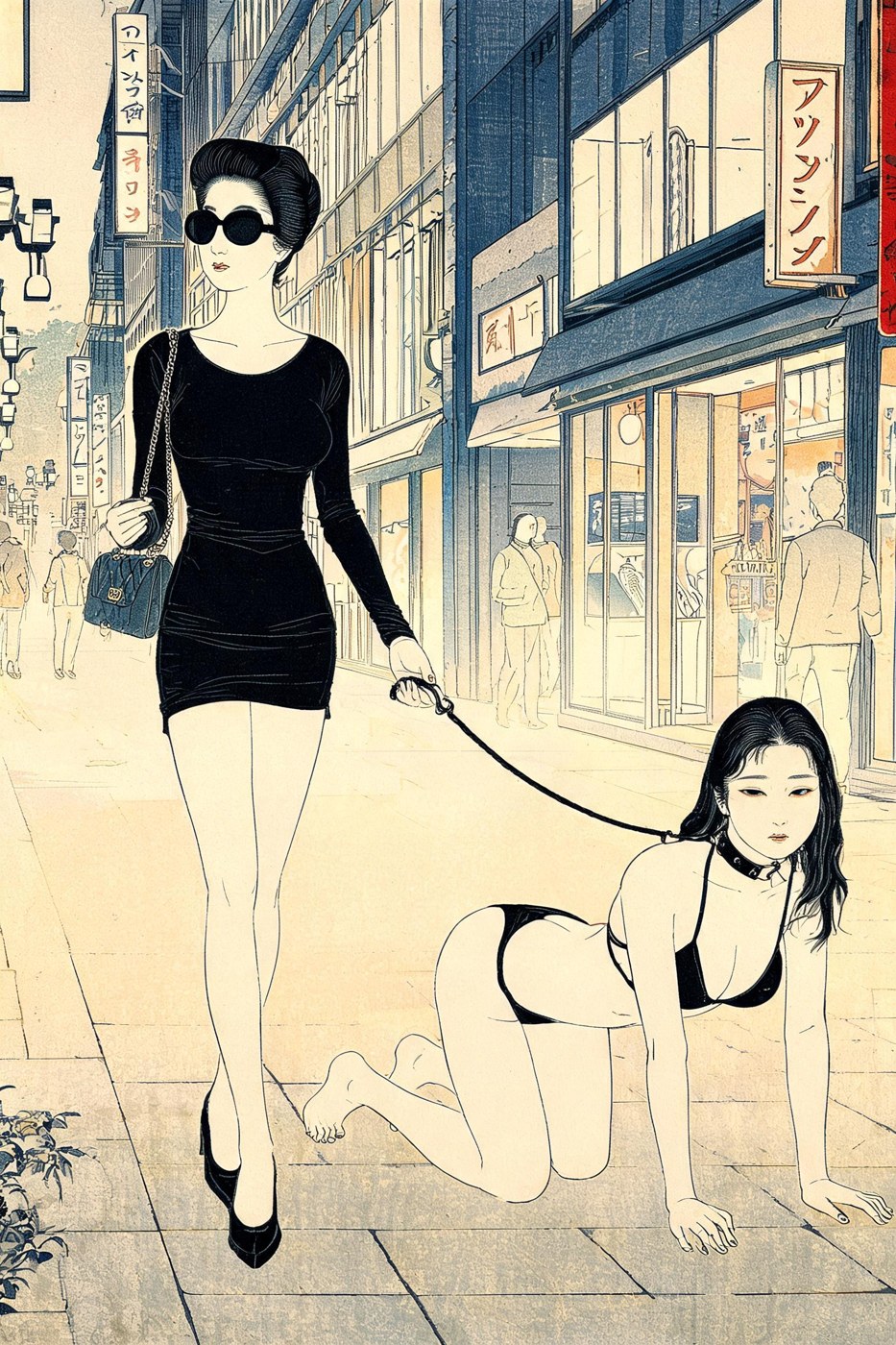
The relief of this is difficult to convey to anyone who has not felt it. It is not the relief of being carried — she is doing the walking. It is the relief of destination being somebody else’s problem. She is fully occupied, entirely engaged, moving her own body at speed through a house, and at no point is she required to have an opinion about any of it. There is a reason women cry the first time. It is almost never distress. It is the specific grief of finding out how heavy something was only after somebody takes it off you.
She will also discover that she walks differently. Shorter steps. Head up, because down pulls the line. Hips looser, because she has stopped bracing. A woman on a leash moves like a woman who has been told she is beautiful, and the reason is that she has stopped doing the thing she does with her body all day, which is decide what to do with it.
IV. THE PULL
Now the pulling, since she’ll insist.
Mechanically it is very simple. A short sharp draw on the line moves her head before she has agreed to move it. That is the whole event, and everything the pull does to her comes out of that single fact: her body obeyed before she did.
She did not decide to lift her chin. Her chin was lifted. There was no interval in which she considered complying, no moment where she gave permission — the instruction went straight past the part of her that deliberates and arrived directly in the muscle. And that, delivered through the spine four or five times an hour, is proof of a kind she cannot argue with. She can talk herself out of a feeling. She cannot talk herself out of having already moved.
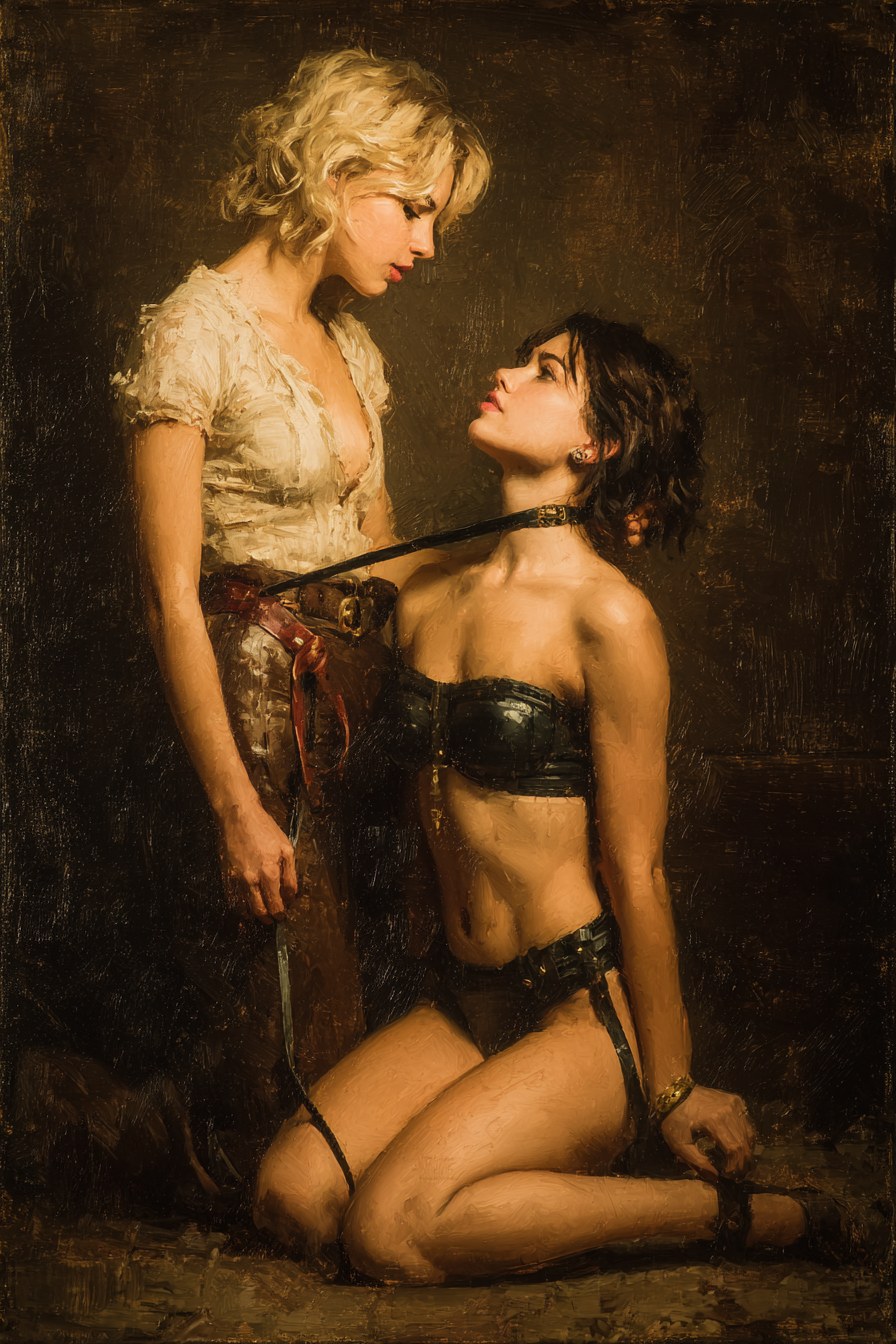
The throat matters here too, and not incidentally. Everything a woman does to signal availability she does with her throat: tips her head, turns her neck, lifts her chin. A pull on a leash performs that gesture for her, correctly, in an instant, without her consent and without her having to be brave enough to do it herself. It is the answer she wanted to give and was never going to manage to give unprompted.
The sound she makes is not one she chose either. Ask her afterwards and she will be embarrassed about the sound long after she has stopped being embarrassed about anything else.
And the small ones — the little corrective tug, half an inch, barely a movement — do more than the big ones. A hard pull is an event. A tiny one is supervision: proof she is being watched constantly, by somebody with a hand on her, who noticed her attention drift and brought it back without troubling to say a word about it.
V. THE ANIMAL
Underneath all of this is a wish that women find much harder to admit than any amount of rough handling, which is the wish to stop being a person for a while.
Not to be degraded. That is the common misreading and it is lazy. The wish is to be reclassified.
Look at what a pet actually is. A pet has no obligations. A pet is never asked its opinion and is never blamed for the outcome. A pet has no calendar, owes nobody an email, is not responsible for anyone else’s feelings and has never in its life had to decide what to do about a difficult situation. It is fed. It is kept. It is walked, at a time somebody else chooses, along a route it does not need to know. And it is loved — thoroughly, physically, without conditions and without any expectation that it will be interesting in return.
That is the offer. And when a woman on a leash goes down onto her hands and knees, or pants, or comes to a sound rather than to her name, she is not performing humiliation. She is taking the offer. The four-footedness is not the fetish; the four-footedness is the paperwork — the visible act of filing herself under a different category so that everyone in the room, including her, can stop expecting her to behave like the other thing.

The relief on her face is genuine and it is not sexual in origin, though it becomes sexual within about ninety seconds. It is the relief of a woman who has put something down.
VI. THE HAND AT THE OTHER END
The leash does something to the woman holding it too, and almost nothing is written about this.
The first ten minutes are dull. That surprises people. She is standing in her own house holding a strap, and there is a moment where the whole thing seems slightly ridiculous and she wonders whether she is doing it right.
Then she moves, and the other woman moves with her, and something in her chest reorganises permanently.
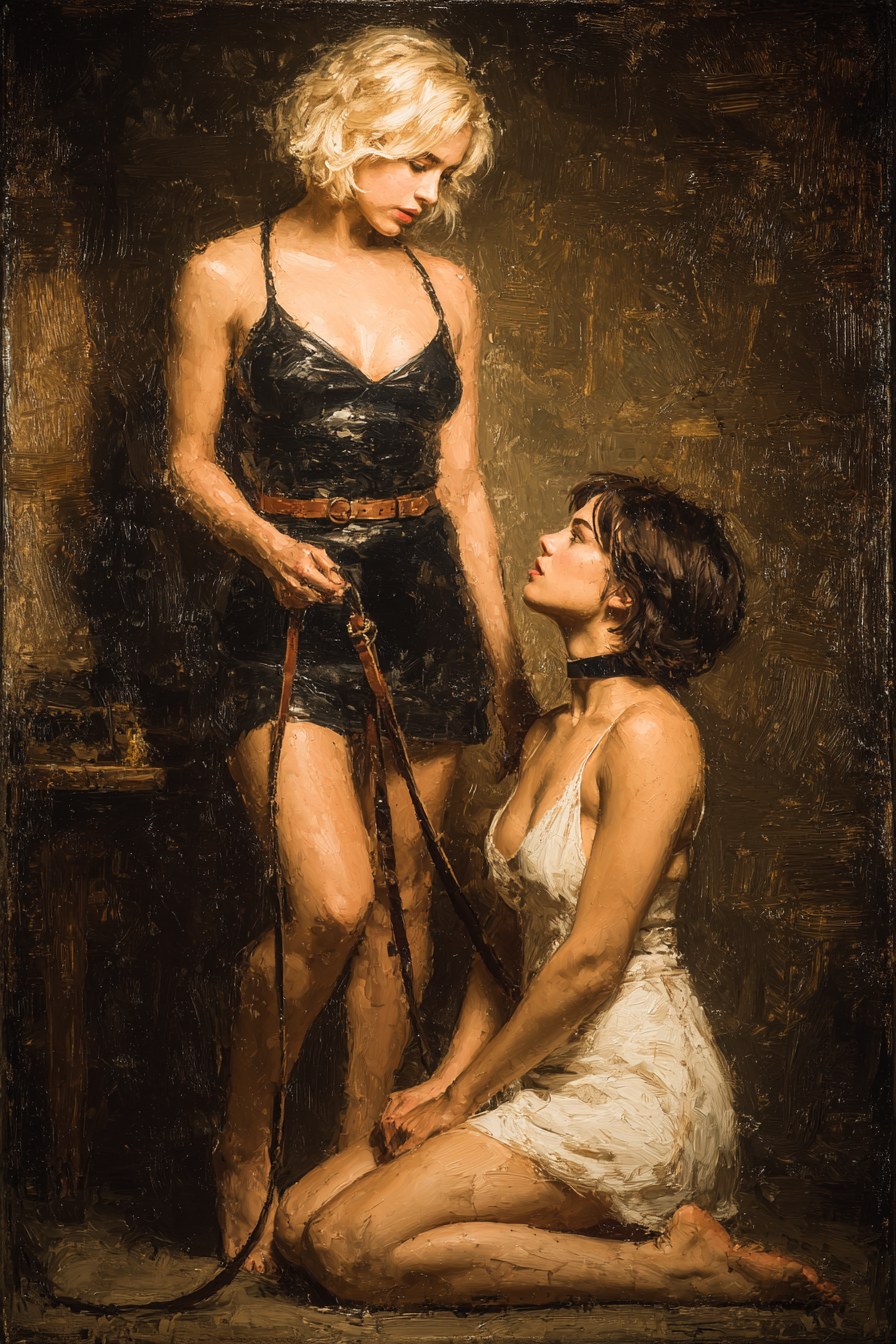
What she has, for the first time, is a woman whose location is her responsibility. Not her care — anyone can care for someone. Her responsibility, in the physical, mechanical sense: if she walks, this woman walks; if she stops, this woman stops; if she is careless near a doorway, this woman is hurt. There is no version of holding a leash properly that is not an act of constant, low-level attention, and most women who take it up discover within an hour that they are better at attention than they knew, and that being needed at that resolution is more absorbing than any amount of being desired.
And she will feel, through the line, everything happening at the other end. The leash is a two-way instrument. She can feel hesitation in it. She can feel eagerness — the small forward pressure of a woman going slightly faster than she has been told to, which is the most flattering sensation available to anyone.
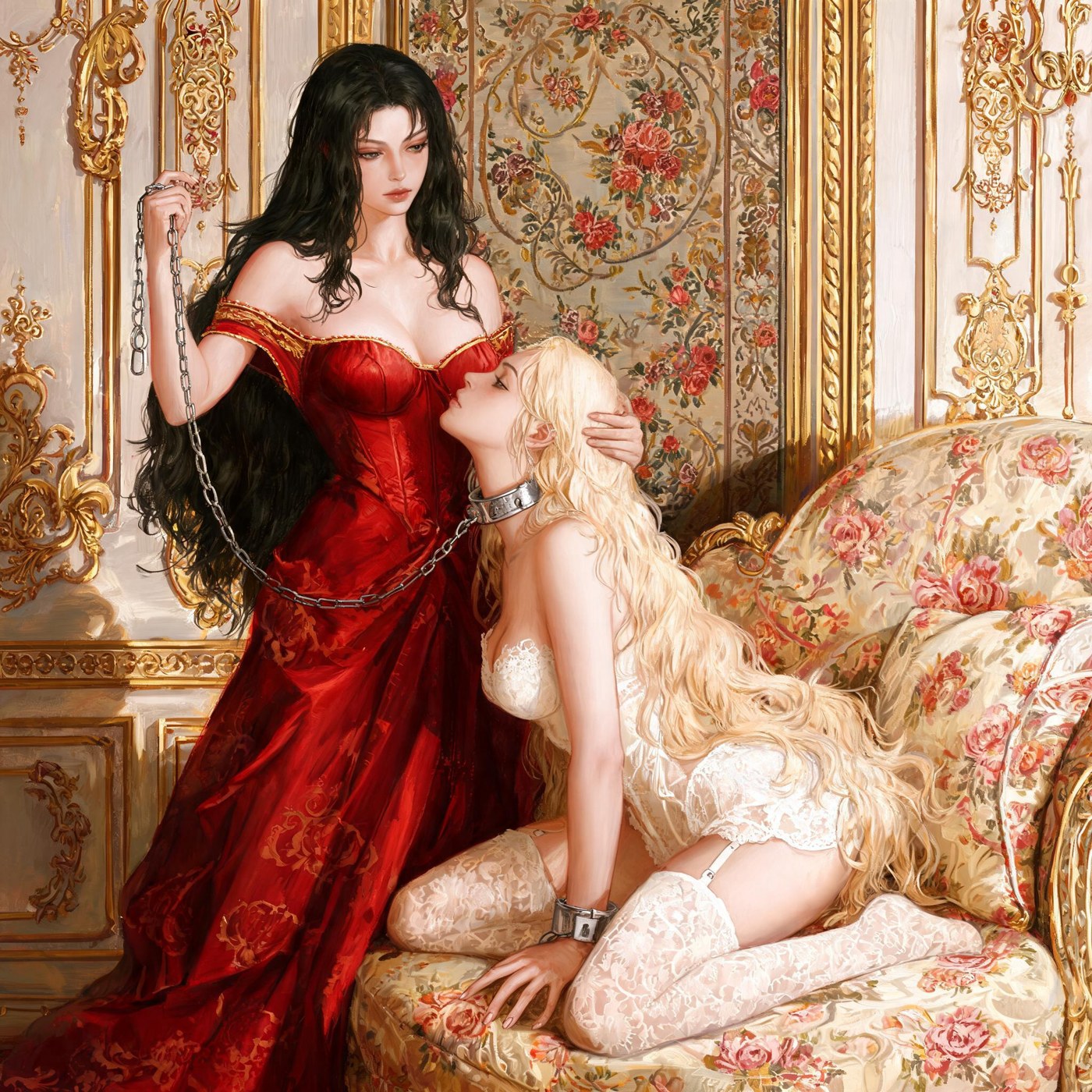
She will also find she does not want to put it down, and she will not admit that for some weeks.
VII. WHAT IT COSTS
Everything on this road costs something and the leash costs more than it appears to, because of one property no other object on the list has.
A collar can be worn in a room a woman is free to leave. A leash cannot. The leash is the first object in the sequence that physically removes her ability to walk out — not symbolically, not by agreement, but as a matter of hardware and geometry. For as long as it is clipped on, leaving is not something she can decide to do. It is something that has to be granted.
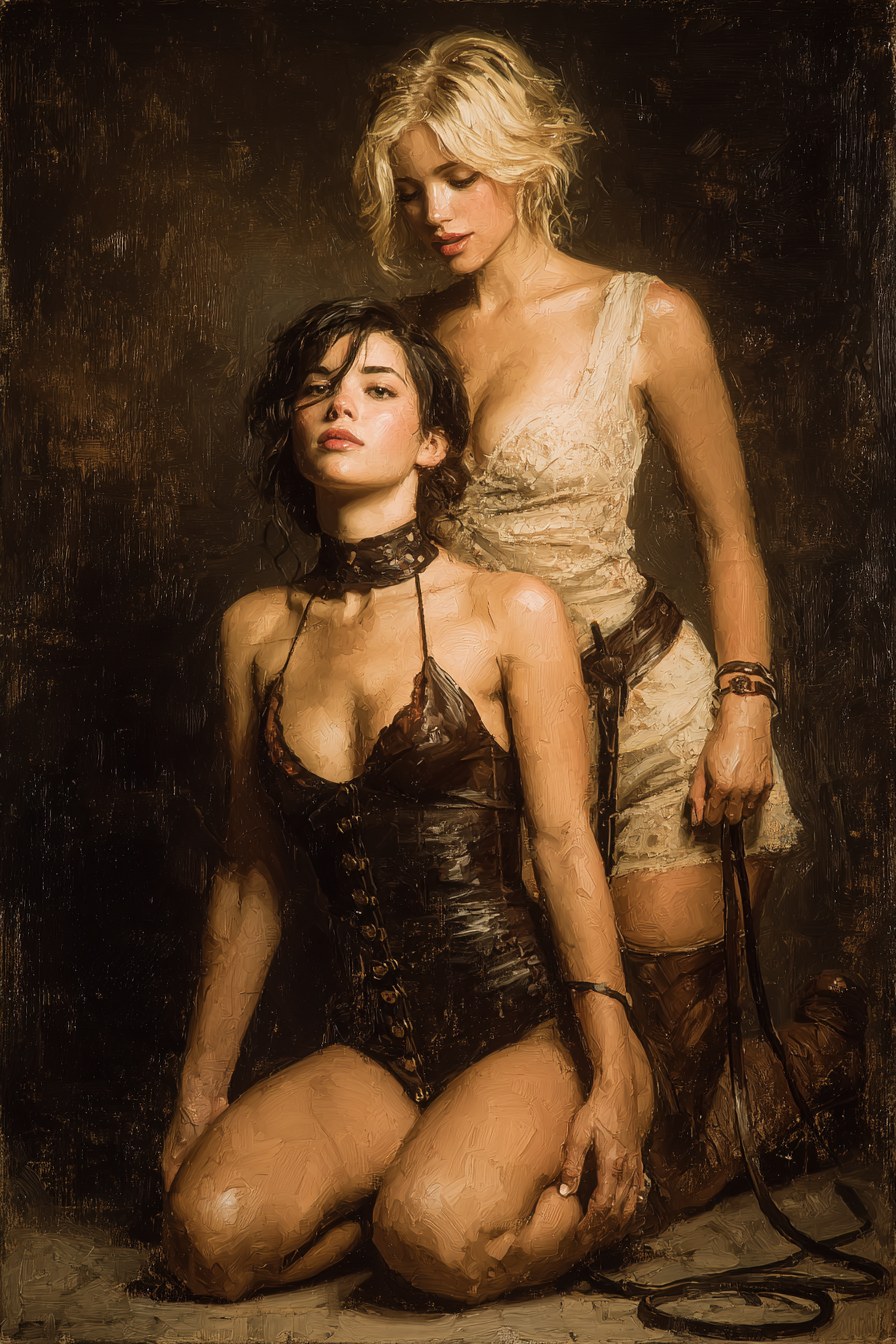
That is the whole of it, and it is why the leash is a threshold rather than an accessory.
Because once a woman has felt what it is to be in a room she cannot leave — and has felt the specific, disgraceful, total calm that came over her when she stopped being able to — she is going to have some difficulty afterwards with rooms she can.
She will not say this. She will say she liked the pulling.